
Enter numerator and denominator for each fraction
Add 1/3 and 1/6; the common denominator makes the result 1/2.

Add, subtract, multiply or divide two fractions.
Common denominators make addition possible, while simplifying afterward can produce a smaller equivalent fraction.
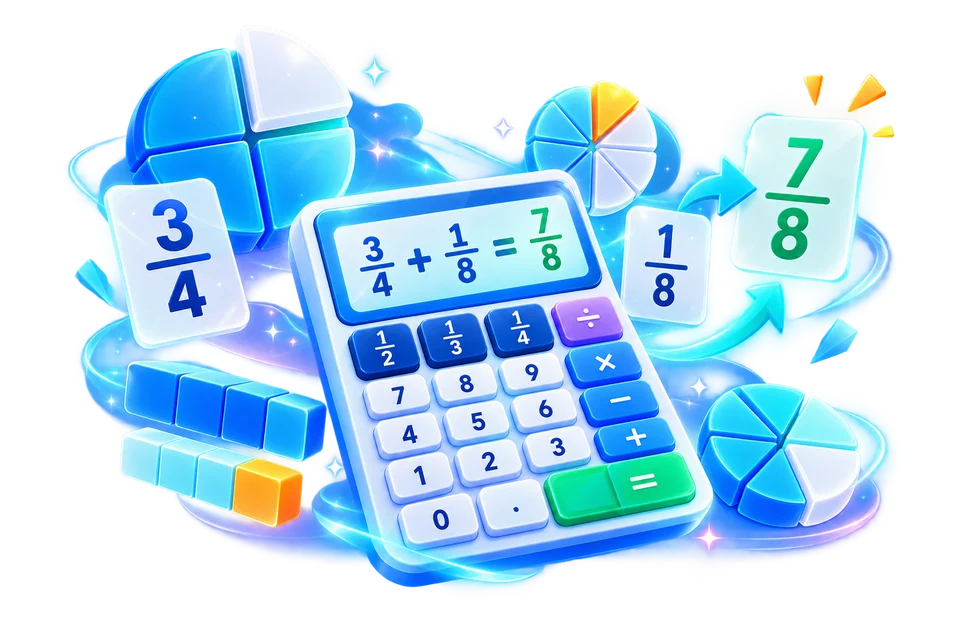
Add 1/3 and 1/6; the common denominator makes the result 1/2.
Add fractions with different denominators.
Reduce the final fraction and check the denominator is not zero.
Add 1/3 and 1/6; the common denominator makes the result 1/2.
One third plus one sixth is one half: convert 1/3 to 2/6, then calculate 3/6 and reduce it. Do not add 3 and 6 to form a denominator of nine.
Use the real tool above to verify the result. The example illustrates the workflow, not a guaranteed outcome.
One third plus one sixth is one half: convert 1/3 to 2/6, then calculate 3/6 and reduce it. Do not add 3 and 6 to form a denominator of nine.
A denominator of zero is undefined. A simplified answer may look different from an equivalent unsimplified fraction, so compare values rather than text alone.

Common denominators make addition possible, while simplifying afterward can produce a smaller equivalent fraction.
Common denominators make addition possible, while simplifying afterward can produce a smaller equivalent fraction.
Add 1/3 and 1/6; the common denominator makes the result 1/2.
Reduce the final fraction and check the denominator is not zero.
One third plus one sixth is one half: convert 1/3 to 2/6, then calculate 3/6 and reduce it. Do not add 3 and 6 to form a denominator of nine.
A fraction represents a quantity divided into equal parts. In 3/4 the numerator is three and the denominator is four; the denominator cannot be zero. To add 1/3 and 1/6, use a shared denominator: 1/3 becomes 2/6, so the sum is 3/6 or 1/2. Adding numerators and denominators directly would give 2/9, which is incorrect. Make sure negative signs and parentheses are entered in the intended order; −1/2 is different from 1/(−2) in notation but has the same value.
For multiplication, numerators multiply and denominators multiply: 2/3 × 9/10 = 18/30 = 3/5. For division, multiply by the reciprocal of the second fraction: (2/3) ÷ (4/5) = (2/3) × (5/4) = 5/6. The second fraction must not be zero. If the tool simplifies the result automatically, compare the resulting value rather than the literal unreduced numerator and denominator from your manual calculation.
A mixed number 2 1/4 means 2 + 1/4, or 9/4 as an improper fraction. Depending on the control, you may need to convert it manually before entry; don't assume a space-separated mixed-number format is recognised. Decimals can be converted to fractions when they represent exact terminating values. For instance, 0.125 = 125/1000 = 1/8. Repeating decimals require different reasoning: 0.333... equals 1/3 but a typed 0.333 is only an approximation.
In a recipe, scaling 3/4 cup by a factor of 2 gives 3/2 cups, often written as 1½ cups. Measurement units must stay consistent; adding a half cup to 200 millilitres requires conversion before doing arithmetic. A fraction calculator handles the numbers, not ingredient density or culinary rounding. A result such as 7/8 is less than one, while 9/8 exceeds one; checking magnitude makes unreasonable outputs easy to notice.
Estimate before trusting an answer. Two positive fractions each smaller than one have a product smaller than either original fraction, but their sum could exceed one. If 1/4 × 1/3 returns something larger than 1, suspect that multiplication was entered as division. For subtraction 1/2 − 3/4, the result is −1/4; the negative sign matters even if you later report an absolute difference. Keep the order of operations explicit with parentheses when mixing addition, multiplication and division.
To verify that 6/8 and 3/4 represent the same quantity, cross-multiply: 6×4=24 and 8×3=24. This method avoids depending on the calculator's display format. When using fraction results in financial or measurement calculations, note whether the next step expects a decimal, a percentage or a reduced ratio. Three quarters can be written as 0.75 or 75%, but the percent symbol changes the interpretation of the number 75. Copying just the digits can make an otherwise correct fraction calculation appear wrong in another form.
A useful magnitude check is placing fractions between adjacent whole numbers. Seven halves is 3.5, so a displayed result of 7/2 should be understood as three complete units plus one half. For negative results, −3/4 lies between −1 and zero; it is closer to −1 than −1/4 is. This visual reasoning helps detect a reversed subtraction or incorrectly applied negative sign. In many practical tasks the reduced fraction and its decimal equivalent should be noted together to avoid confusion.
For a recipe using 3/4 cup of flour and another using 2/3 cup, addition requires a common denominator: 9/12 + 8/12 = 17/12, or 1 5/12 cups. Converting both values into decimals early can obscure an exact simple result. Multiplication is different: 3/4 × 2/3 = 6/12 = 1/2. Explain to a learner why adding numerators and denominators directly is not equivalent to adding quantities. If the interface asks for numerator and denominator separately, never enter a denominator of zero. For mixed numbers, convert to improper fractions carefully before attempting comparison or multiplication.
For addition, convert to equivalent fractions with a common denominator before combining the numerators.
Reducing common factors makes comparison and later calculation easier while preserving the fraction's value.
Improper fractions make arithmetic and algebra easier. Mixed numbers can be clearer when describing measures to people.
Multiply by its reciprocal, provided the divisor is nonzero. Dividing by 0/5 is undefined.