
Enter a differentiable function with its variable
Differentiate x³−4x and verify the result as 3x²−4 by differentiating term by term.

Find symbolic first and higher-order derivatives for common algebraic, trigonometric, exponential and logarithmic expressions.
The calculator can handle many polynomial, trigonometric, exponential and logarithmic expressions. Select the variable and derivative order before solving.
For multivariable expressions, choose the variable you want to differentiate with respect to. The returned expression is symbolic rather than a pre-rounded decimal.
Derivatives describe instantaneous change.
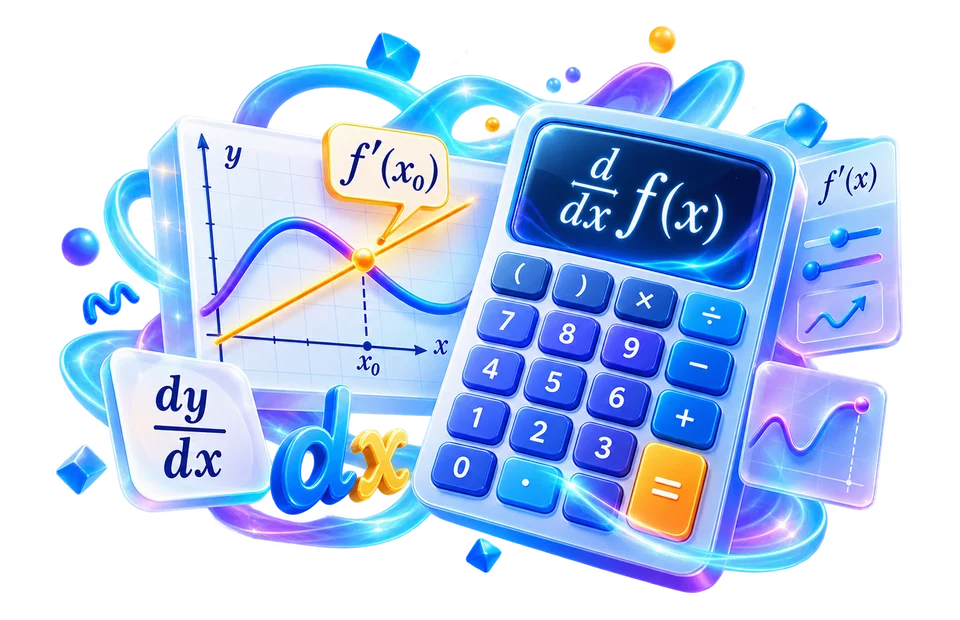
Differentiate x³−4x and verify the result as 3x²−4 by differentiating term by term.
Find the derivative of a polynomial or trigonometric expression.
Check supported notation and the domain of the expression.
Differentiate x³−4x and verify the result as 3x²−4 by differentiating term by term.
For f(x)=x³+2x, the derivative is 3x²+2. At x=2 the instantaneous slope is 14; that is not the same as the original function value of 12.
Use the real tool above to verify the result. The example illustrates the workflow, not a guaranteed outcome.
For f(x)=x³+2x, the derivative is 3x²+2. At x=2 the instantaneous slope is 14; that is not the same as the original function value of 12.
A derivative describes a rate of change with respect to the chosen variable. At cusps or discontinuities an ordinary derivative may not exist.

Differentiate x³−4x and verify the result as 3x²−4 by differentiating term by term.
For f(x)=x³+2x, the derivative is 3x²+2. At x=2 the instantaneous slope is 14; that is not the same as the original function value of 12.
The derivative describes the instantaneous rate at which a function changes as its input changes. For f(x) = x³, the symbolic derivative is 3x². At x = 2, the slope is 12 units of output per unit of input; that is not the function value, which is 8. A practical example is a distance model s(t) = 5t² measured in metres: its derivative 10t gives velocity in metres per second when t is in seconds. Units help catch confusion between an original quantity and its rate of change.
When entering a function, use the syntax supported by the expression parser, especially around multiplication, exponents and parentheses. If the field expects a variable name, choose the symbol that actually varies. Differentiating x²y with respect to x while treating y as constant differs from differentiating it with respect to y. Higher-order derivatives mean differentiating the previous derivative again: for f(x) = x³, first order is 3x², second order is 6x and third order is 6. The selected order should match the question being asked.
Not every function has a derivative at every point. The absolute-value function |x| has a sharp corner at zero; its left-hand slope is −1 and right-hand slope is +1, so there is no single derivative there. A function can also become undefined outside its natural domain: ln(x) over real numbers requires x greater than zero. If a symbolic tool produces a formula with a denominator, inspect points at which that denominator becomes zero. A mathematical expression may be valid over most values and invalid at one important boundary.
As a sanity check, estimate the slope numerically: calculate [f(x+h) − f(x−h)]/(2h) using a small nonzero h and compare with the symbolic derivative at an interior point. Do not use an extremely tiny h in floating-point arithmetic because subtraction can amplify rounding error. For f(x)=x² at x=3, the centred estimate should be near 6. This numerical technique is a cross-check, not a replacement for exact differentiation and domain analysis.
A derivative equal to zero identifies a stationary point, not automatically a maximum. f(x)=x³ has zero derivative at x=0 but no local maximum there. Likewise, a positive derivative over an interval suggests increasing behaviour there, but that statement must be applied only where the function is defined and differentiable. If the tool displays notation such as d/dx or f'(x), read it as an operation on a function. Keep the original formula in your notes so results are not mistaken for equations to solve.
Consider a business model whose revenue in rupees is R(q)=100q−q² for selling q units in a simplified setting. The derivative R'(q)=100−2q expresses marginal revenue. At q=20 it equals 60, meaning a small increase in quantity near that point changes revenue at an approximate rate of sixty rupees per additional unit. This is not the same as the average revenue R(q)/q. The model itself is an illustration: practical pricing decisions require market data, integer quantities and costs not represented in this one mathematical function. Reading the output with its units prevents a correct differentiation from becoming an unsupported business conclusion.
A graph of y = x³ has a horizontal tangent at x = 0 because its derivative 3x² becomes zero there, but that does not make x = 0 a local maximum or minimum. This example is a useful check against assuming every stationary point is a turning point. Choose the expression and differentiation variable on the dedicated page, and decide whether the answer should be a symbolic derivative or a numerical slope at a particular value. An output containing x is a derivative function, not necessarily a single rate. Before copying into homework, evaluate an easy input and compare against a small finite-difference estimate where the function is smooth.
Differentiate each term separately and compare signs and powers; a constant contributes zero.
Differentiate each term separately and compare signs and powers; a constant contributes zero.
Only when the original function represents position as a function of time. For other functions, it measures change in the relevant units.
No. For x³ at zero, the derivative vanishes even though the curve keeps increasing. Additional analysis is necessary.
A corner can have different left and right slopes. A single tangent slope does not exist unless those limits agree.