
Specify the integrand and integration variable
Integrate 2x and differentiate your answer to check it returns 2x.

Calculate indefinite or definite integrals symbolically where possible.
Indefinite integration returns an antiderivative plus the constant of integration. Definite integration uses the selected lower and upper bounds.
Not every mathematical expression has an elementary closed-form antiderivative. If the symbolic engine cannot fully integrate an expression, use the Numerical Methods calculator for trapezoidal or Simpson approximation.
Integration reverses differentiation in many familiar cases, but a family of antiderivatives differs by an additive constant.
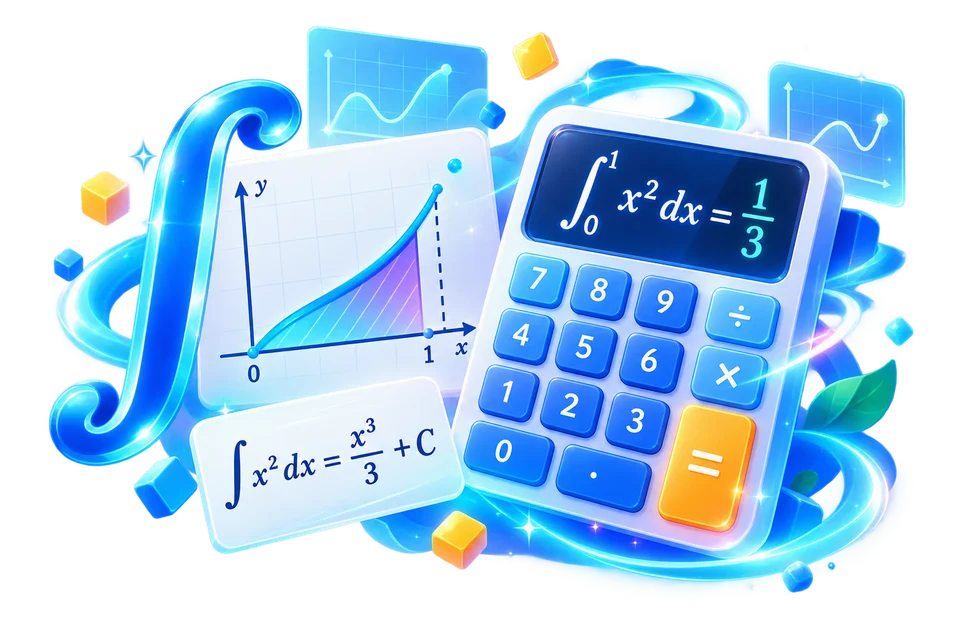
Integrate 2x and differentiate your answer to check it returns 2x.
Find an antiderivative or evaluate a definite integral.
Indefinite integrals include an arbitrary constant.
Integrate 2x and differentiate your answer to check it returns 2x.
An antiderivative of 2x is x²+C, because differentiating x²+C gives 2x. For a definite interval such as 0 to 2, x² evaluated at the endpoints gives 4.
Use the real tool above to verify the result. The example illustrates the workflow, not a guaranteed outcome.
An antiderivative of 2x is x²+C, because differentiating x²+C gives 2x. For a definite interval such as 0 to 2, x² evaluated at the endpoints gives 4.
An indefinite integral is a family of functions. Definite and indefinite integrations have different outputs and should not be conflated.

Integration reverses differentiation in many familiar cases, but a family of antiderivatives differs by an additive constant.
Integration reverses differentiation in many familiar cases, but a family of antiderivatives differs by an additive constant.
Integrate 2x and differentiate your answer to check it returns 2x.
An antiderivative of 2x is x²+C, because differentiating x²+C gives 2x. For a definite interval such as 0 to 2, x² evaluated at the endpoints gives 4.
Indefinite integration asks for a family of functions whose derivative equals the entered expression. The integral of 2x with respect to x is x² + C, where C is an arbitrary constant. Differentiating that answer gives 2x because the derivative of a constant is zero. Definite integration instead evaluates between specified bounds. From x = 0 to x = 2, the definite integral of 2x is [x²] from 0 to 2, giving 4. The displayed result may therefore be a formula or a number, depending on the selected integral type.
A definite integral measures signed accumulation, not necessarily an ordinary geometric area. For f(x)=x from −1 to 1, the negative contribution cancels the positive, giving zero. The area enclosed between the curve and the horizontal axis is positive and would require splitting the interval and integrating absolute values. A tool calculating a signed integral has not made an error if it returns zero for a region with equal positive and negative lobes. State what the question asks before interpreting the result.
The variable of integration matters. Integrating x with respect to x gives x²/2 + C, but x treated as a constant while integrating with respect to t gives xt + C. For a definite integral, put lower and upper limits in their intended order. Reversing the limits changes the sign: ∫ from 2 to 0 of 2x equals −4. If the expression contains a discontinuity, a direct numeric evaluation may be misleading. The integral of 1/x across an interval including zero requires special treatment rather than applying logarithm antiderivatives across a forbidden point.
To verify an indefinite result, differentiate it and simplify. For a definite integral with a simple integrand, compute by a second method such as geometry: ∫ from 0 to 3 of 2 dx is a rectangle of width 3 and height 2, so its value is 6. For more complex functions, compare a numerical estimate with the symbolic expression while remembering numerical approximation can be inaccurate near rapid variation or singularities.
Integration appears in accumulated distance from velocity, total quantity from a flow rate and area under a rate curve. If a pipe delivers 4 litres per minute at a constant rate for 5 minutes, integrating 4 over time gives 20 litres. If the rate varies, a time-dependent expression is needed. The integral does not automatically correct bad units, recover a missing physical model or confirm experimental measurements. Be explicit about assumptions, input domain and whether the answer needs a constant of integration.
If a speed function has metres per second and the input variable is seconds, integrating speed over time produces metres travelled under suitable assumptions. Integrating acceleration over time produces velocity change, not distance directly. In a financial context, integrating a rate in rupees per month over months yields rupees, but only if both variables use consistent units. These dimensional checks often reveal that a wrong function was entered even when the integration itself was mathematically valid. For a decimal output, compare a coarse numerical approximation to the symbolic answer before rounding the final reported quantity.
Integrating 6x with respect to x gives 3x² + C, because the derivative of 3x² is 6x. For a definite integral from 0 to 2, the same antiderivative yields 12 after evaluating both boundaries; the constant cancels. Keep indefinite and definite tasks separate when choosing inputs and interpreting results. If a tool produces a symbolic answer, test it by differentiating, not just by matching a familiar formula from a reference sheet. Piecewise functions, absolute values and functions with discontinuities may require examining intervals separately. A numerical quadrature result is an approximation and should not be represented as a proven closed-form antiderivative.
It represents any constant; differentiating that constant gives zero, so multiple antiderivatives have the same derivative.
It represents any constant; differentiating that constant gives zero, so multiple antiderivatives have the same derivative.
Yes. On a connected interval, two antiderivatives of the same function may differ by a constant.
No. Approximate areas can be computed even when a convenient symbolic antiderivative is unavailable.
The same function produces different signed areas over different intervals. Reversing limits reverses the integral's sign.