
Write the equation with explicit parentheses
Solve x²−5x+6=0 and substitute both candidate roots into the original equation.

Solve algebraic equations and simultaneous systems with symbolic results where possible.
Use explicit multiplication such as 2*x and standard functions such as sin(x), sqrt(x) and log(x). You can enter multiple equations on separate lines and list the variables as x,y.
Polynomial and many common functional equations can be solved symbolically or numerically by the symbolic engine. Extremely complex or under-specified systems may not produce a closed-form solution.
An algebraic solver can produce candidates that need checking, especially after squaring or multiplying by expressions that could be zero.
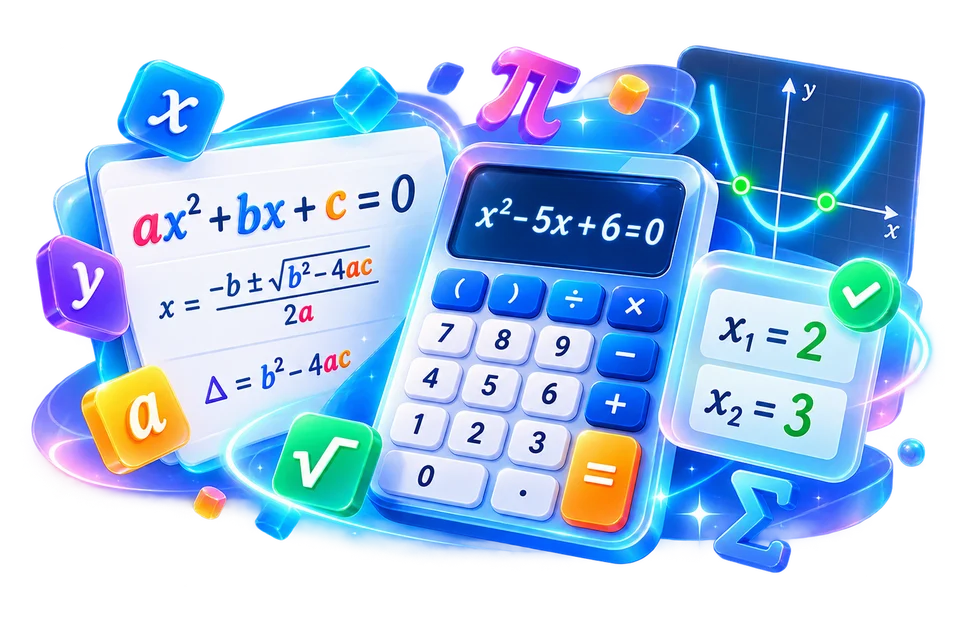
Solve x²−5x+6=0 and substitute both candidate roots into the original equation.
Solve a quadratic equation or a small system of equations.
Review extraneous solutions when equations contain denominators or radicals.
Solve x²−5x+6=0 and substitute both candidate roots into the original equation.
The equation x²−5x+6=0 has roots 2 and 3 because each makes the left side zero. When square roots or denominators occur, substitution is even more important.
Use the real tool above to verify the result. The example illustrates the workflow, not a guaranteed outcome.
The equation x²−5x+6=0 has roots 2 and 3 because each makes the left side zero. When square roots or denominators occur, substitution is even more important.
Keep restrictions from the starting equation: multiplying by a potentially zero denominator can introduce an invalid candidate.

An algebraic solver can produce candidates that need checking, especially after squaring or multiplying by expressions that could be zero.
An algebraic solver can produce candidates that need checking, especially after squaring or multiplying by expressions that could be zero.
Solve x²−5x+6=0 and substitute both candidate roots into the original equation.
The equation x²−5x+6=0 has roots 2 and 3 because each makes the left side zero. When square roots or denominators occur, substitution is even more important.
An algebraic equation states that two expressions have the same value. In 2x + 5 = 15, subtract five from both sides to get 2x = 10 and divide by two to get x = 5. Checking is simple: substitute five into the original left side and confirm it equals fifteen. An expression such as 2x + 5, without an equals sign, is not the same request as solving an equation. When the interface offers multiple variables, keep the variable list consistent with the actual symbols in the entered equations.
For two unknowns, independent conditions are needed. The pair x + y = 10 and x − y = 2 gives x = 6 and y = 4. A single equation x + y = 10 does not identify a unique pair because many values satisfy it. A numerical solver may return an empty set, one solution or multiple candidates depending on the system. Do not assume any output labeled "solution" exhausts every possible real or complex value unless the chosen method and domain actually guarantee that.
Squaring both sides can introduce answers that do not satisfy the starting equation. For example, √x = −2 has no real solution because the principal square root is nonnegative, even though squaring gives x = 4. Fractions add excluded values: (x² − 1)/(x − 1) = 0 is not valid at x = 1. Substitute each proposed solution into the initial unsimplified equation, including its denominators, square roots and logarithms. That final check often catches a misleading algebraic manipulation.
In a linear system, parallel constraints can be inconsistent. x + y = 1 and x + y = 2 cannot both hold. Conversely, x + y = 1 and 2x + 2y = 2 are equivalent and have infinitely many solutions rather than a unique pair. Correctly identifying no solution and infinitely many solutions is as important as finding numbers. A tool returning a warning or a parameterized answer may be describing these valid mathematical cases, not failing to calculate.
Equations appear in bill splitting, mixture prices, dimensions and break-even analyses. If two adult tickets and one child ticket cost ₹500 while one adult and two child tickets cost ₹400, define adult price a and child price c and solve 2a + c = 500 and a + 2c = 400; the prices are ₹200 and ₹100. The letters should be defined before solving. If an answer includes a decimal approximation, retain enough precision for the intended use; rounding prices early can shift a later total. Never confuse a symbolic identity with a numerical root.
A root such as 1/3 may display as 0.333333, which is useful for estimation but not mathematically identical to the exact rational form unless the repeating decimal is understood. If a problem requests an exact answer, retain a fraction or radical when the solver supplies it. For geometric dimensions or physical measurements, check whether a negative algebraic root makes sense in the real-world context; x²=25 has roots ±5, but a measured length generally cannot be negative. Rejecting a value for practical reasons is different from saying it is not a mathematical solution.
If a quadratic equation is entered as x² − 5x + 6 = 0, its two roots are 2 and 3: both make the polynomial zero. A solver may return a list, exact factors or decimal approximations, depending on the supported method. Do not treat an approximate display as proof that only one root exists. After solving, substitute each proposed root into the original equation; this catches sign mistakes and invalid roots introduced when both sides were squared. For equations with denominators, write forbidden values down before rearranging terms. If the page asks for coefficients, enter those in their designated fields rather than typing the entire equation into an unrelated numeric input.
Substitute it into the original equation. A candidate that breaks the original domain is not a valid root.
Squaring both sides, changing denominators or applying other non-equivalent transformations can introduce extraneous solutions.
Yes. Squaring loses sign information. Every candidate root must satisfy the unsquared original equation.
Substitute it back and inspect the residual. Use additional precision when the result is near a critical boundary.