
Enter the transform-domain expression in s
If the supported input is 1/(s+2), compare the time-domain result with e^(−2t).

Calculate inverse Laplace transforms for supported expressions.
Enter a transform-domain expression such as 1/(s^2+1). The symbolic engine attempts to recover the corresponding time-domain expression.
Inverse transform support is narrower than basic algebra or differentiation, so some valid transforms may remain unevaluated.
A transform-domain fraction can represent an exponential, oscillation or other time response.
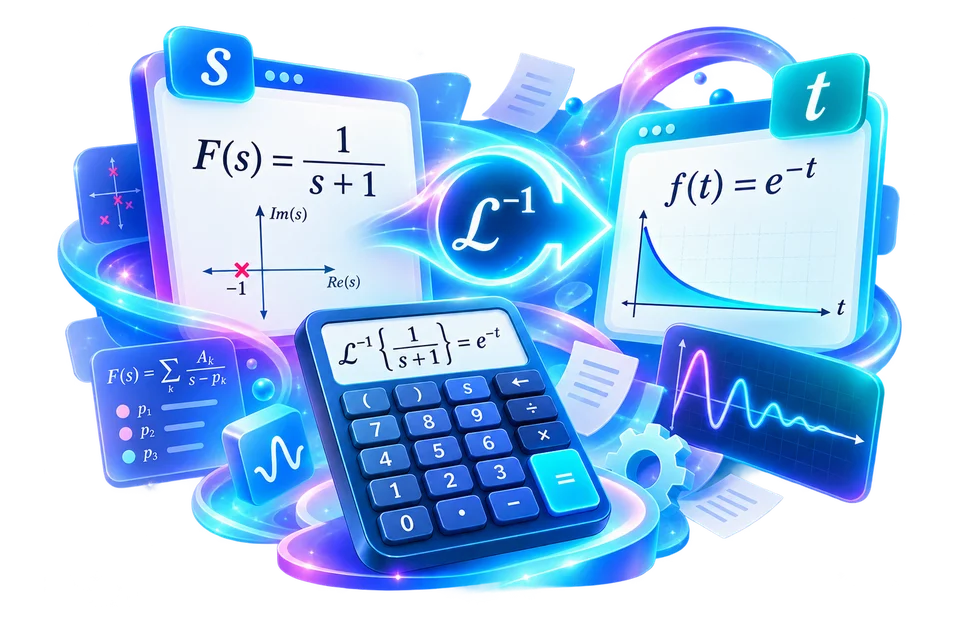
If the supported input is 1/(s+2), compare the time-domain result with e^(−2t).
Convert a supported frequency-domain expression to a time-domain form.
Complex expressions may fall outside the supported symbolic set.
If the supported input is 1/(s+2), compare the time-domain result with e^(−2t).
The inverse Laplace transform of 1/(s+2) is e^(−2t) for t≥0 in the usual one-sided convention. The 2 shifts the exponential's decay rate.
Use the real tool above to verify the result. The example illustrates the workflow, not a guaranteed outcome.
The inverse Laplace transform of 1/(s+2) is e^(−2t) for t≥0 in the usual one-sided convention. The 2 shifts the exponential's decay rate.
Pay attention to poles and the assumed time-domain convention. A transform expression alone may not specify all physical initial conditions.

A transform-domain fraction can represent an exponential, oscillation or other time response.
A transform-domain fraction can represent an exponential, oscillation or other time response.
If the supported input is 1/(s+2), compare the time-domain result with e^(−2t).
The inverse Laplace transform of 1/(s+2) is e^(−2t) for t≥0 in the usual one-sided convention. The 2 shifts the exponential's decay rate.
The inverse Laplace transform starts with an expression F(s) and seeks a corresponding original function f(t). One standard pair is F(s)=1/(s+3), whose inverse is e^(−3t) for t≥0 under the usual unilateral-transform convention. This is not accomplished by replacing the letter s with t. The denominator structure encodes exponential time behaviour. Enter the transform expression using the supported syntax, and keep the transform variable separate from the output time variable.
Another familiar pair is F(s)=s/(s²+4), which corresponds to cos(2t). Meanwhile, 2/(s²+4) corresponds to sin(2t); the differing numerator changes the time-domain result. For a sum of terms, linearity lets you invert terms separately where the transform exists. If an input contains a higher-order polynomial denominator, partial fractions may help derive an answer by hand. A symbolic tool may leave an unevaluated transform if it cannot recognise the form.
The most reliable cross-check is applying a forward Laplace transform to the proposed time function and simplifying the resulting expression. For example, forward-transform e^(−3t) and confirm that 1/(s+3) is recovered in its region of convergence. Note that different books may use unilateral or bilateral conventions and additional initial-condition assumptions. Do not interpret an inverse formula as a complete solution to a differential equation unless the initial conditions and forcing function have been incorporated correctly.
For control-system work, the s-domain expression can represent an impulse response, transfer function or solution of an initial-value problem; those objects are related but not interchangeable. A transfer function alone does not specify the complete time response for every input. If results include step functions or distributions such as Dirac impulses, review whether the tool supports those symbolic forms. A smooth-looking approximation may omit a mathematically important impulse component.
Inverse transforms are commonly used after solving a linear differential equation in the Laplace domain. For y' + 3y = 0 with y(0)=2, the transform gives Y(s)=2/(s+3), leading back to y(t)=2e^(−3t). The initial value changes the numerator without changing the decay rate. A useful dimensional check is that s has inverse-time units, so any constant added to s must have compatible units. If a solution grows unexpectedly, inspect signs in the denominator and the original equation.
The expression 1/(s+2)² is related to t·e^(−2t), not simply e^(−2t). A repeated pole changes the time-domain shape by introducing a factor of t. That distinction matters in system-response problems because early growth and eventual decay can coexist. A first-order denominator and a squared denominator should not be treated as the same transform pair. If a symbolic output looks surprising, factor the denominator, inspect multiplicities, and test the forward transform of the proposed result. Pole locations alone do not always determine all coefficients or initial-condition effects.
An inverse Laplace calculation works from an expression in the variable s back toward a time-domain signal. For example, 1/(s+2) corresponds to an exponential decay e^(−2t) for the usual causal convention. This is different from reading a number out of a simple numeric calculator. Retain brackets around denominators when typing rational expressions; 1/s+2 describes another function from 1/(s+2). A delay factor e^(−3s) has a distinct meaning from a pole shift s+3, so copy the original transform accurately. A supported symbolic response should be checked by transforming it forward under the same conventions.
For repeated calculations, keep a reference sheet of transform pairs and their valid conditions. A rational expression such as (s+1)/(s²+2s+2) may require algebraic rearrangement before it matches a standard pair. If a result contains a sine or cosine term, compare its frequency and exponential factor separately. This is more reliable than checking only the overall visual shape of a formula, especially when negative signs or shifted variables are involved.
Poles, powers and coefficients change the corresponding time-domain function; compare the exact expression rather than guessing.
Replacing s with s+a corresponds to multiplying the time-domain signal by an exponential factor in the standard transform pair.
Yes. Standard causal-transform conventions and the region of convergence affect how expressions correspond to signals.
The parentheses change the mathematical expression. One represents a rational transform, the other adds a constant to 1/s.